.svg)
Shopify EDI
When Does a Shopify Store Need EDI?
5 min readPublished JUL 6, 2021Updated JUN 24, 2026
ADMIN
A
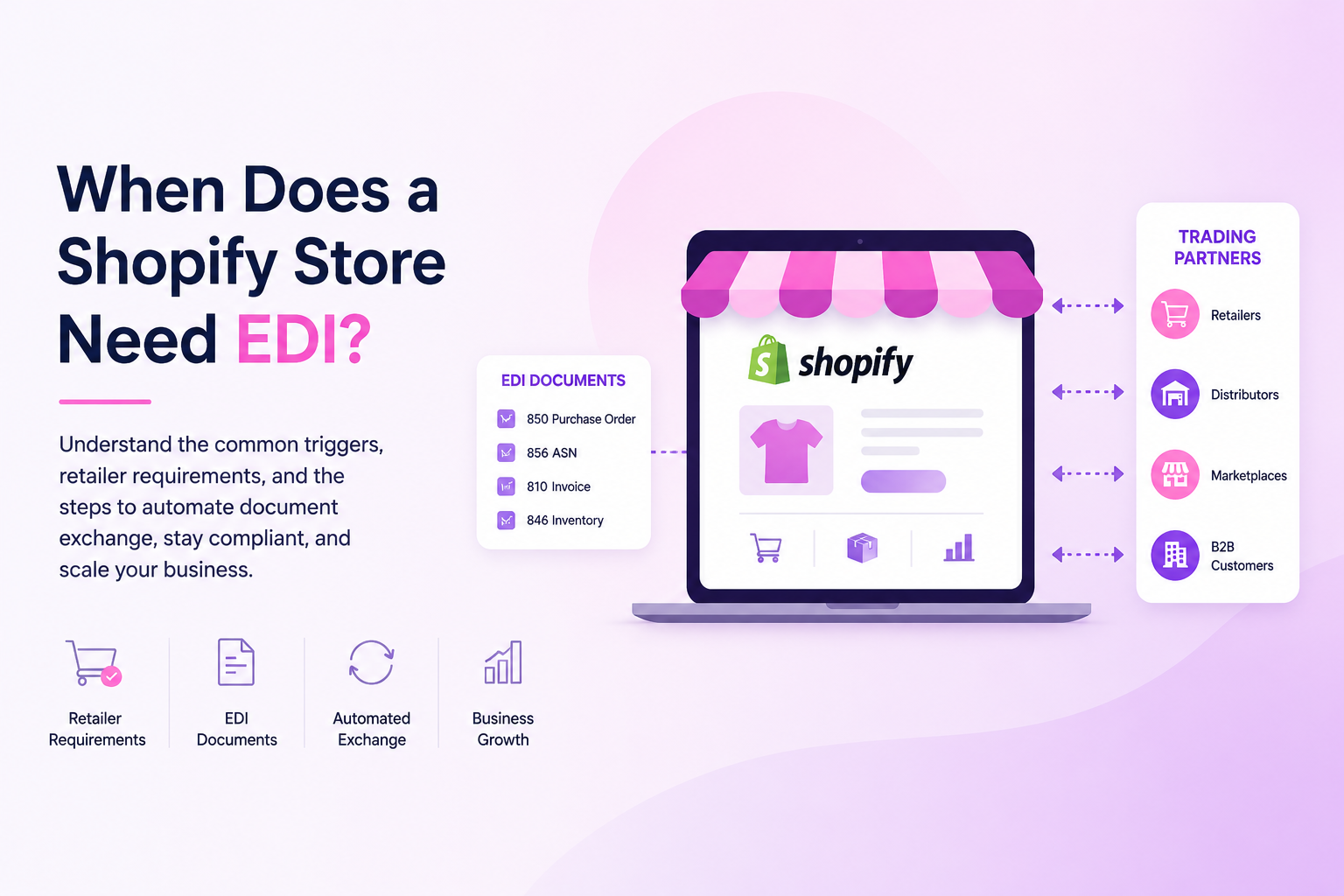
Shopify is a leading e-commerce platform that empowers anyone to create an online store and sell products. With features like inventory tracking, order management, shipping, etc., Shopify empowers businesses to sell across websites and marketplaces. According to Forbes, “Shopify is rated as the best e-commerce platform for integrations.” As of 2026, over 4 million websites run on Shopify, serving drop-shippers, small and medium businesses, and B2B enterprises.
Why does EDI matter for Shopify?
Most businesses don't start with EDI when they launch on Shopify. EDI becomes necessary when retailers, distributors, marketplaces, or B2B customers require electronic document exchange as a condition of doing business. Without EDI, teams often rely on manual order entry, spreadsheet-based inventory updates, email communications, and error-prone fulfillment processes.
EDI automates the exchange of purchase orders, invoices, advance ship notices, inventory updates, and other business documents between Shopify and trading partners. This helps businesses improve accuracy, reduce manual effort, meet retailer compliance requirements, and scale operations without increasing administrative workload.
Common Situations Where Shopify Stores Need EDI
- A retailer requires EDI as part of onboarding.
- A marketplace mandates electronic document exchange.
- A distributor requests EDI purchase orders and invoices.
- Order volume makes manual processing difficult to manage.
- The business needs to meet retailer compliance requirements.
What Should You Do When a Retailer Requires EDI?
Most Shopify businesses follow a structured process to meet retailer EDI requirements:
1. Understand Your Retailer Requirements
Identify the EDI documents, communication protocols, compliance rules, and testing requirements your trading partners require.
Identify the EDI documents, communication protocols, compliance rules, and testing requirements your trading partners require.
2. Design Your Data Flows
Define how orders, inventory, shipments, and invoices will move between Shopify, your EDI platform, and other business systems.
Define how orders, inventory, shipments, and invoices will move between Shopify, your EDI platform, and other business systems.
3. Connect Shopify to Your EDI Platform
Use Shopify APIs and webhooks to connect Shopify with an EDI platform that handles document translation, compliance, and partner communications.
Use Shopify APIs and webhooks to connect Shopify with an EDI platform that handles document translation, compliance, and partner communications.
4. Map and Automate Transactions
Map Shopify data to EDI documents such as 850 Purchase Orders, 856 ASNs, 810 Invoices, and 846 Inventory Updates, then automate workflows.
Map Shopify data to EDI documents such as 850 Purchase Orders, 856 ASNs, 810 Invoices, and 846 Inventory Updates, then automate workflows.
5. Test, Certify, and Go Live
Validate every transaction flow, complete retailer certification requirements, and launch with monitoring in place to ensure smooth operations.
Validate every transaction flow, complete retailer certification requirements, and launch with monitoring in place to ensure smooth operations.
This process ensures EDI compliance for Shopify, laying the foundation for reliable communication, automation, and smoother operations with your retail partners.
How Zenbridge Simplifies Shopify EDI
Zenbridge helps businesses connect Shopify with retailers, distributors, marketplaces, and business systems through a flexible EDI platform designed for rapid onboarding and long-term scalability. Rather than managing retailer requirements, communication protocols, document mapping, and compliance internally, businesses can rely on Zenbridge to simplify connectivity and automate EDI workflows from order receipt through fulfilment and invoicing.
- Unrestrictive Trading Partner Connectivity: Connect with any retailer, distributor, supplier, or marketplace using AS2, SFTP, APIs, VANs, or partner-specific communication methods.
- EDI Translation & Compliance Management: Support ANSI X12, EDIFACT, and retailer-specific requirements while ensuring documents are translated, validated, and exchanged accurately.
- Flexible Integration Architecture: Integrate Shopify with ERPs, WMSs, shipping platforms, accounting systems, and other business applications using APIs and event-driven workflows.
- Faster Onboarding & Go-Lives: Leverage proven implementation methodologies and retailer onboarding expertise to reduce deployment timelines and accelerate production readiness.
- Managed Support & Trading Partner Onboarding: Simplify testing, certifications, production changes, and ongoing partner management with dedicated EDI expertise.
- Scalable Growth Foundation: Automate purchase orders, invoices, ASNs, inventory updates, and other EDI transactions while supporting new trading partners as your business expands.
Business Benefits of Shopify EDI
- Automate Order Processing – Convert retailer purchase orders into fulfilment-ready orders without manual intervention.
- Improve Inventory Visibility – Keep inventory synchronized across Shopify, retailers, and business systems in near real time.
- Reduce Manual Errors – Eliminate repetitive data entry and minimize costly operational mistakes.
- Maintain Retailer Compliance – Meet retailer and marketplace EDI requirements with automated document exchange.
- Scale Trading Partner Connectivity – Add new retailers and partners without increasing administrative workload.
- Accelerate Cash Flow – Streamline order-to-cash processes through faster, more reliable document exchange.
These benefits help Shopify businesses improve operational efficiency, support retailer compliance, and scale trading partner relationships with confidence.
Case Studies: How Shopify Businesses Use EDI in Practice
Shenanigan Kids, a fast-growing children’s e-commerce brand, leveraged Zenbridge’s EDI-as-API platform to automate Shopify order processing automation with major retailers like Amazon and Walmart, reducing order processing errors by 30% and scaling operations efficiently.
Similarly, Craftie Fox, a Shopify dropshipping store, used Zenbridge’s Shopify EDI platform to simplify Shopify supplier integration and enable real-time inventory updates, ensuring retail compliance and reducing fulfilment time by 25%.
These successes demonstrate how EDI for Shopify transforms e-commerce operations for businesses of all sizes.
Ready to Connect Shopify with Your Trading Partners?
Shopify provides the flexibility to support modern commerce, but retailers, distributors, and marketplaces often require EDI to exchange business documents and maintain compliance. A well-designed EDI workflow automates order processing, inventory synchronization, fulfilment updates, and invoicing, helping Shopify businesses meet retailer requirements while scaling efficiently. With Zenbridge, you gain a flexible EDI platform, unrestricted trading partner connectivity, and the expertise needed to accelerate onboarding and simplify ongoing operations.
Get started today
Ready to get started?
From first connection to full automation, we handle the heavy lifting.
Get your EDI up and running without complexity & delays.