
EDI vs APIShopify EDI Integration
Best Shopify EDI Providers in 2026: Traditional EDI vs API-First Solutions
6 min readPublished JUN 30, 2026Updated OCT 5, 2026
SHELLY
CONTENT WRITER

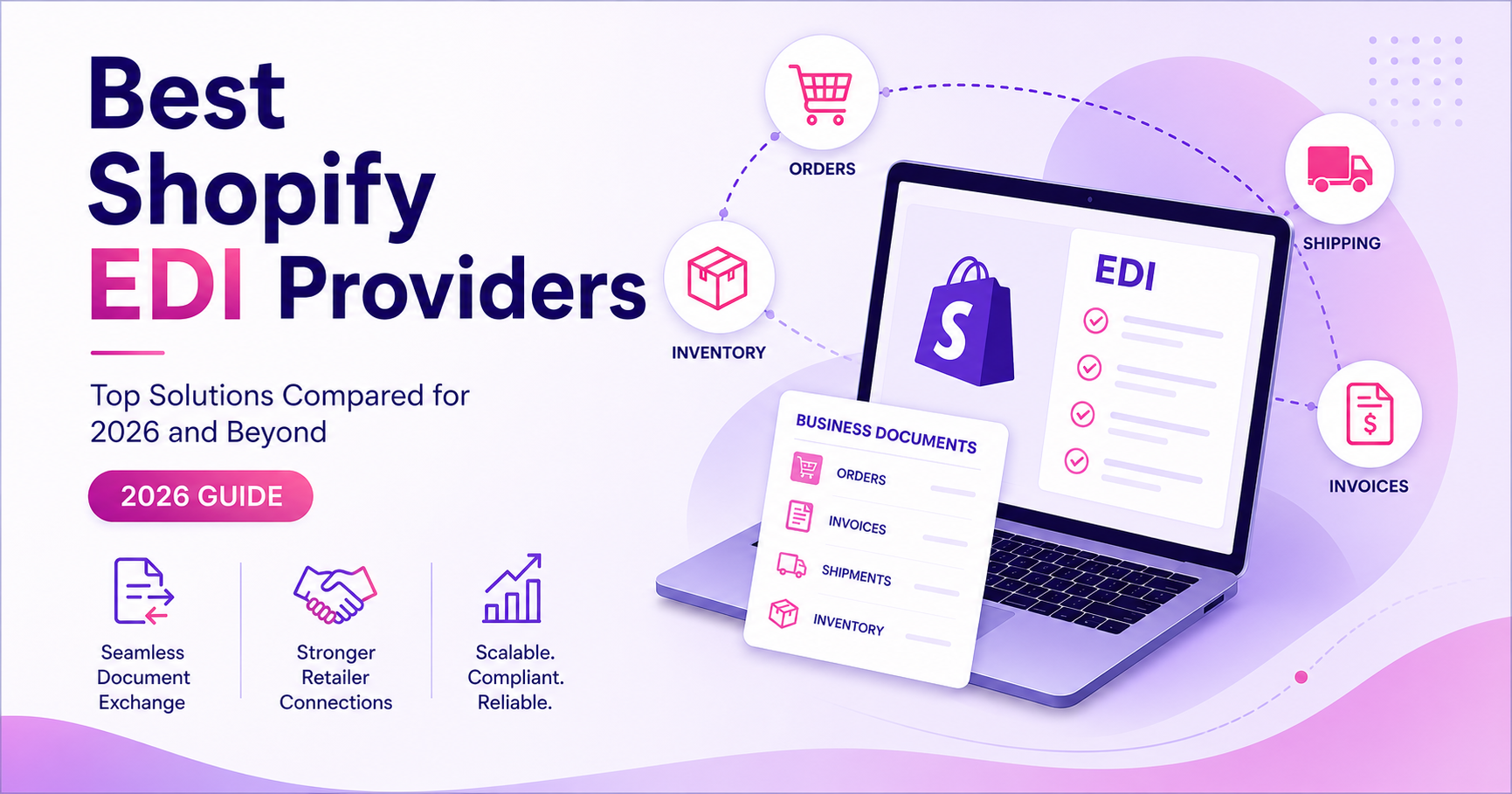
As Shopify continues to power millions of ecommerce businesses worldwide, more merchants are expanding into wholesale, B2B commerce, and large retail partnerships. While Shopify excels at managing online sales, retailers such as Amazon, Walmart, Target, Costco, and other major trading partners often require suppliers to exchange business documents using Electronic Data Interchange (EDI).
This requirement has created a growing market for Shopify EDI providers. However, not all EDI solutions are built the same.
Businesses evaluating Shopify EDI software today face two distinct options:
- Traditional EDI providers built on legacy EDI networks and managed services
- Modern API-first EDI platforms designed specifically for cloud commerce ecosystems
In this guide, we compare the leading Shopify EDI providers in 2026, examine the strengths and limitations of each approach, and help you determine which solution best fits your business.
What Makes a Great Shopify EDI Provider?
Choosing an EDI provider is about more than simply exchanging documents. The right solution should support your long-term growth strategy while minimizing operational complexity.
When evaluating Shopify EDI vendors, consider the following factors:
- Shopify platform compatability
Can the platform connect directly with Shopify APIs and webhooks, or does it require custom middleware and manual development?
How easily can the provider connect with retailers, distributors, suppliers, marketplaces, and logistics partners?
Does the platform integrate with systems such as NetSuite, QuickBooks, Zoho Books, SAP, Microsoft Dynamics, or warehouse management systems?
- Deployment Speed
How long does implementation take? Days, weeks, or several months?
- Scalability
Can the platform support growing order volumes without requiring major infrastructure changes?
Are costs predictable, or are there hidden fees for onboarding, mapping, and transaction volumes?
Will your team need dedicated EDI specialists, or does the provider simplify maintenance and compliance management?
These factors often determine whether an EDI implementation becomes a growth enabler or an ongoing operational burden.
Traditional EDI Providers vs Modern API-First Solutions
Traditional EDI providers were designed for enterprise environments long before cloud commerce platforms existed. Modern EDI platforms, by contrast, are built around APIs, webhooks, and cloud-native architectures.
| Evaluation Criteria | Traditional EDI Providers | Modern API-First Solutions |
|---|---|---|
| Architecture | Legacy EDI networks and VANs | Cloud-native EDI-as-API |
| Shopify Integration | Often requires middleware | Direct Shopify connectivity |
| Implementation Time | 3–6 months | Days to weeks |
| Real-Time Processing | Limited | Webhook-driven automation |
| Scalability | Infrastructure dependent | Cloud scalability |
| Maintenance | Internal IT involvement | Vendor-managed |
| Pricing Model | Licensing + transaction fees | Subscription-based |
| Ease of Use | Complex | Business-user friendly |
For many modern ecommerce brands, API-first EDI solutions provide faster deployments and lower operational overhead while maintaining retailer compliance.
Best Shopify EDI Providers in 2026
1. Zenbridge
Zenbridge takes a different approach to EDI by treating EDI transactions as APIs rather than traditional file exchanges.
Its EDI-as-API architecture is designed specifically for modern commerce platforms and enables businesses to automate order processing, inventory synchronization, shipment notifications, and invoicing without the complexity associated with legacy EDI systems.
Key Advantages
- Pre-built Shopify connectors
- API-first architecture
- Native webhook support
- Rapid onboarding
- Real-time order and inventory synchronization
- Support for ANSI X12 and EDIFACT
- ERP integrations including NetSuite, QuickBooks, and Zoho Books
Why Businesses Choose Zenbridge
Unlike many traditional providers, Zenbridge focuses on reducing implementation timelines while simplifying retailer connectivity.
This makes it particularly attractive for businesses looking to move quickly without building custom integrations.
2. IBM Sterling B2B Integrator
IBM Sterling remains one of the most established names in the EDI industry. It provides extensive capabilities for document exchange, partner management, security, and compliance.
Strengths
- Enterprise-grade security
- Extensive partner management capabilities
- Advanced workflow orchestration
- Global deployment options
Challenges
- Lengthy implementation cycles
- Significant IT involvement
- Higher total cost of ownership
- Shopify integration varies; confirm connectors, webhooks, and APIs.
IBM Sterling is typically best suited for organizations with large-scale integration requirements and dedicated technical teams.
3. TrueCommerce
TrueCommerce offers a large trading partner network and managed EDI services.
Strengths
- Extensive retailer connectivity
- Managed service offerings
- Established market presence
- ERP integration options
Challenges
- Less emphasis on platform-specific features
- Longer onboarding timelines
- Additional customization often required
Businesses already invested in the TrueCommerce ecosystem may find value in extending their existing infrastructure to Shopify.
4. SPS Commerce
SPS Commerce has built a strong reputation around retailer onboarding and compliance.
Strengths
- Large retailer network
- Retail compliance expertise
- Managed onboarding services
- Strong support for retail supply chains
Challenges
- Limited platform optimization
- Traditional implementation model
- Less flexibility for API-driven workflows
For companies heavily focused on retail compliance, SPS Commerce remains a recognized option.
5. Emerging API-First EDI Providers
Several newer vendors are entering the Shopify EDI market with cloud-native architectures and API-first designs.
These providers often emphasize:
- Faster deployment
- Lower upfront costs
- Simplified integrations
- Cloud scalability
However, many lack the retailer network depth, implementation experience, and proven customer success records established providers offer.
Shopify EDI Providers Compared
| Provider | Primary Strength | Typical Use Case | Deployment Model |
|---|---|---|---|
| Zenbridge | Shopify and ecommerce automation | Fast retailer onboarding and workflow automation | Cloud-native SaaS |
| IBM Sterling | Enterprise B2B integration | Complex enterprise ecosystems | Enterprise and cloud deployment options |
| TrueCommerce | Retail network connectivity | Multi-channel retail operations | Managed cloud service |
| SPS Commerce | Retail compliance management | Retail supplier onboarding and compliance | Managed cloud service |
EDI Provider Evaluation Checklist for Shopify
Before selecting a provider, ask these important questions:
1. How quickly can the solution be implemented?
Lengthy projects can delay retailer onboarding and revenue opportunities.
2. Does the platform provide pre-built Shopify connectivity?
Pre-built connectors significantly reduce deployment complexity.
3. Is the platform webhook-enabled?
Real-time processing improves inventory visibility and order accuracy.
4. What ERP systems are supported?
Ensure compatibility with your existing technology stack.
5. How are retailer requirements managed?
Retail compliance rules vary significantly between trading partners.
6. What is the total cost of ownership?
Consider implementation costs, maintenance requirements, support fees, and transaction pricing.
Why Modern Ecommerce Brands Are Moving Toward EDI-as-API
Traditional EDI systems were built for an era dominated by batch processing, VAN networks, and on-premise infrastructure.
Today's ecommerce environment requires:
- Real-time order processing
- Continuous inventory synchronization
- Faster retailer onboarding
- Cloud-native scalability
- API-driven integrations
As a result, many Shopify businesses are adopting EDI-as-API platforms that align more naturally with modern commerce architectures.
The shift mirrors broader digital transformation initiatives across ecommerce, supply chain, and B2B operations.
Which Shopify EDI Provider Is Right for Your Business?
The best Shopify EDI provider depends on your business size, technical environment, growth objectives, and trading partner requirements.
Choose a traditional EDI provider if:
- You operate a large enterprise environment
- You have dedicated EDI specialists and IT teams
- You require highly customized B2B workflows
- Long implementation cycles are acceptable
Choose an API-first EDI platform if:
- You need faster deployment
- You want direct Shopify integration
- You prefer real-time automation
- You want lower operational complexity
- You are scaling ecommerce and retail partnerships rapidly
Final Thoughts
The Shopify EDI market is changing rapidly. While traditional EDI vendors continue to serve large enterprise environments, modern API-first platforms are becoming the preferred choice for growing ecommerce businesses seeking agility, scalability, and faster time-to-value.
For Shopify merchants evaluating EDI solutions in 2026, the decision often comes down to balancing enterprise complexity against speed, flexibility, and ease of integration.
Platforms such as Zenbridge represent a new generation of EDI technology that combines retailer compliance with modern API architecture, helping businesses automate order processing, inventory management, fulfillment communication, and partner connectivity without the challenges associated with traditional EDI systems.
As retail ecosystems become increasingly digital, selecting the right Shopify EDI provider can play a critical role in enabling long-term growth and operational efficiency.
Expert Guidance
Evaluating NetSuite EDI Vendors?
Compare integration approaches, implementation timelines, and support options before choosing a NetSuite EDI provider.