
NetSuite EDI Integration
NetSuite EDI for 3PL integration
7 min readPublished APR 20, 2026Updated JUL 23, 2026
SHELLY
CONTENT WRITER

Retail supply chains today operate as tightly connected ecosystems where retailers, third-party logistics providers (3PLs), and warehouses must coordinate in near real-time. In such environments, Electronic Data Interchange (EDI) is not just a communication protocol—it is the operational backbone that determines how reliably orders move from purchase to fulfillment and invoicing.
NetSuite is widely used in these ecosystems because it can centralize order management, fulfillment coordination, and financial workflows. However, the real challenge is not whether NetSuite can support EDI, but whether the entire end-to-end flow remains stable under real-world operational conditions such as volume spikes, partner variability, and warehouse dependencies.
Core EDI Transactions in Retail–3PL–Warehouse Flow
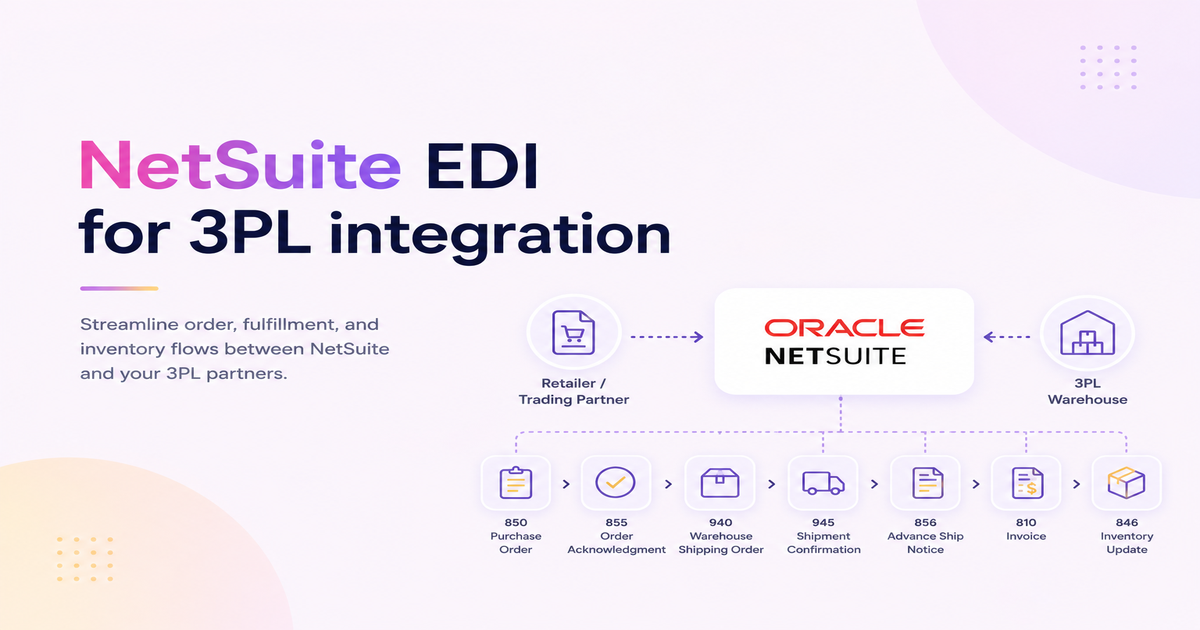
A typical NetSuite-driven supply chain relies on a standard set of EDI transactions:
- 850 – Purchase Order (From Retailer)
- 855 – Order Acknowledgment (To Retailer)
- 940 – Warehouse Shipping Order (To Warehouse/3PL)
- 945 – Shipment Confirmation (From Warehouse)
- 856 – Advance Ship Notice (To Retailer)
- 810 – Invoice (To Retailer)
- 846 – Inventory Update (To Retailer/Partners)
While this structure appears linear, execution is highly non-linear in practice. Each document is dependent on upstream and downstream events, and disruption at any point can cascade across the entire flow.
Why NetSuite EDI Integrations Become Complex
1. Inter-Document Dependencies
The EDI lifecycle functions as a tightly coupled chain rather than a set of independent steps.
For example:
- A delay in 945 (shipment confirmation) directly delays 856 (ASN) generation, which impacts retailer visibility and receiving processes
- ASN delays affect downstream compliance checks and warehouse acknowledgment cycles
- Invoice (810) accuracy depends on both shipment confirmation and fulfillment completeness
Across the ecosystem, multiple such dependencies exist between ordering, fulfillment, inventory updates, and financial transactions. A disruption in one document does not remain isolated—it propagates across several connected business processes.
2. Multi-Warehouse and Split Fulfillment Complexity
In many retail setups, a single order is not fulfilled from one location but distributed across multiple warehouses or 3PL partners.
This introduces operational complexity such as:
- Orders being split across warehouses based on inventory availability or proximity
- Partial shipments where different SKUs are fulfilled at different times
- Variations in execution speed and processing logic across warehouses
- Need for SKU-level accuracy in allocation and tracking
Even small inconsistencies in timing or allocation logic can result in incomplete shipments, delayed ASNs, or mismatched fulfillment records across systems.
3. Partner-Specific Rules
Each trading partner operates with its own set of rules and expectations, which introduces constant variability into the system.
This may include:
- Different EDI formats or required field structures
- Custom validation rules and business logic per partner
- Varying SLA expectations for acknowledgments, shipments, and invoicing
- Different tolerance levels for missing, delayed, or partial data
As a result, there is no single standardized workflow that applies universally. The system must support multiple variations of the same process simultaneously without breaking consistency.
4. SLA-Driven Timing Pressures
SLA compliance in EDI environments is not tied to a single transaction—it is distributed across multiple dependent steps.
For example:
- Delayed 855 acknowledgments can trigger compliance flags from retailers
- Late 945 confirmations compress the available time for ASN generation and invoicing
- Delays in inventory updates affect order promise accuracy and fulfillment planning
These dependencies create tightly compressed execution windows where delays in upstream processes reduce flexibility and increase downstream SLA risk.
5. High-Volume and Burst Transaction Conditions
Retail EDI systems rarely operate at a steady transactional pace. Instead, they experience sudden bursts of activity.
Typical scenarios include:
- Bulk order drops involving hundreds or thousands of transactions at once
- Seasonal demand spikes or promotional events driving sudden load increases
- Simultaneous transaction flows from multiple trading partners
Under these conditions, systems must handle:
- Concurrent processing of large transaction volumes
- Large EDI file ingestion without performance degradation
- Consistent SLA adherence even during peak load periods
Without this capability, even correctly designed workflows begin to fail under operational pressure.
Operational Requirements to Manage This Complexity
Given the interdependent nature of retail–3PL–warehouse EDI flows, stability cannot be achieved through configuration alone. It requires deliberate operational design across workflow structure, testing depth, system observability, and support readiness.
1. End-to-End Workflow Design (Not Isolated Transactions)
EDI workflows must be designed as a single connected lifecycle rather than independent document exchanges.
This requires:
- Explicit mapping of dependencies across the full flow (850 → 940 → 945 → 856 → 810) so downstream impact is always predictable
- Recognition that delays or failures in one document directly affect multiple subsequent processes
- Support for partial shipments, exceptions, and out-of-sequence events without breaking the overall flow
The focus is on ensuring that the entire operational chain remains intact, even when individual steps are delayed or incomplete.
2. Scenario-Based Testing and Stress Validation
Testing must reflect actual operational variability, not ideal scenarios.
This includes:
- End-to-end testing across full document chains rather than isolated transactions
- Multi-warehouse scenarios involving split fulfillment, partial shipments, and timing differences
- Partner-specific rule validation across different trading partners and configurations
- Failure and recovery testing, including retries, missing documents, and incorrect data handling
- High-volume simulation to validate system behavior during burst loads and peak order periods
The objective is to ensure the system remains stable under real-world complexity, not controlled conditions.
3. High-Volume Processing Resilience
Retail EDI systems must be designed and validated for unpredictable spikes in transaction volume.
This requires:
- Ability to process large batches of orders concurrently without backlog formation
- Stable performance during seasonal peaks, promotions, and bulk order drops
- Efficient handling of large EDI files without degradation in processing speed or accuracy
The system must be proven not only for average load, but for maximum expected operational stress.
4. Dependency-Aware Monitoring, Reporting, and Alerts
Monitoring must extend beyond individual transaction status into full workflow visibility.
This includes:
- Cross-document tracking that shows how orders move across the entire lifecycle, not just single events
- Workflow-level reports that identify bottlenecks such as delayed 945 confirmations, stalled ASNs, or pending acknowledgments
- SLA-based alerts that trigger when upstream delays begin impacting downstream timelines, rather than waiting for failure
- Real-time exception reporting for failed, retried, or mismatched transactions across the workflow chain
This ensures operational teams are responding to early risk signals across interconnected processes, not reacting after SLA breaches occur.
5. Structured Hypercare and Continuous Support
Hypercare is a critical operational layer in complex EDI environments, not a short-term post-go-live phase.
It must include:
- Continuous monitoring of all critical workflows across partners and warehouses
- Rapid response mechanisms for cross-system failures and dependency breakdowns
- Coordinated support across ERP, warehouse, and trading partner systems
- Proactive identification of SLA risks before they escalate into operational incidents
- Clear ownership and escalation paths for resolving interdependent workflow issues
In distributed EDI systems, even minor delays can cascade quickly, making structured and proactive support essential for stability.
6. Flexible Partner and Warehouse Adaptability
No two partners or warehouses operate in the same way, making adaptability essential for long-term stability.
This requires:
- Support for partner-specific business rules without redesigning core workflows
- Ability to accommodate warehouse-level differences in processing logic and timing
- Flexibility to evolve workflows as trading partner requirements change over time
The system must remain adaptable without becoming structurally fragile as complexity increases.
Real-World Execution: Managing Complexity at Scale
In a large-scale migration scenario, a lighting solutions manufacturer operating across North America transitioned its EDI system while maintaining integration with NetSuite and more than 30 trading partners.
The environment included high transaction volumes and multiple fulfillment nodes, requiring uninterrupted order-to-cash continuity during migration.
The transition was completed within approximately 30 days without operational disruption.
Key outcomes included:
- Successful onboarding of all trading partners
- Stable processing of high-volume transaction flows
- Continuity of order, shipment, and invoicing processes during migration
- Reduced manual intervention through automation
- Sustained visibility across workflows throughout the transition
This outcome was achieved through:
- Pre-established partner connectivity
- Stress-tested high-volume processing capability
- Scenario-based validation across workflows
- Continuous monitoring during migration
- Structured hypercare support during execution
Conclusion
NetSuite is capable of supporting retail–3PL–warehouse EDI environments, but operational success depends on how well the system is designed, validated, and managed under real-world conditions.
The core complexity arises from:
- Interdependent document workflows
- Multi-warehouse fulfillment structures
- Partner-specific variability
- SLA-driven timing constraints
- High-volume burst processing conditions
In such environments, EDI is not a static integration layer. It is a continuously operating system that must remain stable under constant variability.
Success is determined not by the existence of documented workflows alone, but by their resilience and performance under real-world operational stress.